C-004: TSB Bank IT Migration Failure (2018)
System Layer: Anchor (CI/CD and Runtime Verification)
Analysis Type: Historical Incident Analysis
Incident Date: April 2018
Domain: Operational Resilience / Infrastructure Configuration
Governance Theme: Configuration Integrity & Go/No-Go Decision Attribution
Status: Completed Reference Case
INCIDENT PROFILE // CASE: C-004
- Impact Level: CRITICAL
- Financial Damage: £600M+ (Outage costs, customer redress, regulatory fines)
- Affected Assets: Core Banking Services, Branch Outlets, Mobile App
- Execution Window: Months (Initial outage: days, residual issues: 8 months)
- Root Cause: Cross-Configuration mismatch between dual active data centers
- Anchor Preventability: High (100% Drift and Verification Gate Enforcement)
1. Executive Summary
In April 2018, TSB Bank plc underwent a catastrophic operational meltdown when migrating its core infrastructure from its legacy parent bank (Lloyds Banking Group) to a new proprietary platform called Proteo, designed by Sabadell.
While data migration was technically successful, the production infrastructure itself collapsed immediately upon go-live. A massive configuration mismatch between TSB’s two active data centers locked out 1.9 million online customers, disabled branch systems, and initiated an 8-month period of extreme service instability, culminating in £600M+ in losses and a joint £48.65 million fine by the Financial Conduct Authority (FCA) and Prudential Regulation Authority (PRA) in 2022.
From my perspective, this was a failure of Configuration Governance and Decision Attribution. TSB's board approved the migration based on incomplete information, unaware that only one data center had been tested. Had TSB employed decoupled, sealed configuration guardrails, the mismatch would have triggered a compile-time blocker, and the override to launch without testing the second center would have required an attributable cryptographic signature, preventing silent risk acceptance.
2. Chronological Incident Timeline
The IT migration and subsequent system collapse progressed as follows:
3. Historical Evidence & Verification Chain
I have reconstructed this analysis using verified regulatory notices and official investigation reports:
- FCA & PRA Joint Final Notice (2022): The regulators fined TSB £48.65 million, detailing severe gaps in operational resilience and risk management, noting that TSB failed to adequately organize and control the IT migration.
- Reference: FCA Press Release | Full FCA Final Notice PDF
- TSB Slaughter and May Independent Review (2019): An independent board-commissioned review that exposed the governance gap where the board was informed of only ~800 defects of the actual ~2,000 defects in existence.
- Reference: Slaughter and May Independent Review Report
- House of Commons Treasury Committee Report (2018): Parliament's inquiry into the TSB IT failure, highlighting executive complacency and failure to test dual-center failover.
- Reference: Treasury Committee IT Outages Report
4. Video Documentation & Contemporary Briefings
Here is the compiled audio-visual evidence and contemporary reporting detailing the incident's mechanics and financial impact:
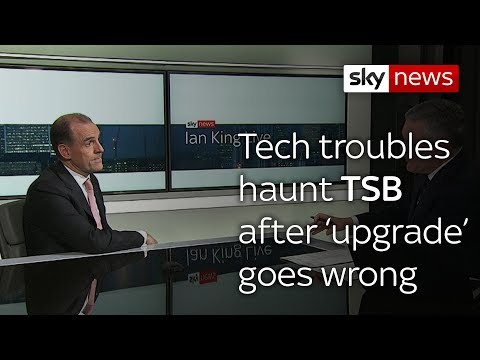
TSB takes down digital services after upgrade fail
Original 2018 reporting from Sky News
TSB 2018 IT Meltdown: Millions Locked Out
Detailed retrospective analysis
Ex-TSB IT Exec Penalized £81K for System Failures in 2018
Outlining individual attribution fines
5. Governance Failure & Root Cause Analysis
From my perspective, this failure was a direct result of an information asymmetry and a missing verification gate:
- Untested Configuration Execution: The active-active data center configuration was deployed to production without being validated in an identical staging topology.
- Information Attribution Gap: The board voted to go-live approval based on a readiness report indicating 800 defects, while 1,200 additional defects were undocumented or unescalated.
- Silent Risk Acceptance: Internal Audit and risk concerns were accepted and bypassed without requiring cryptographically sealed, individually attributable sign-offs.
The Observational Gap
Under traditional infrastructure monitoring, configuration verification is post-hoc:
6. How Anchor Changes the Outcome
Anchor shifts verification from a post-hoc human audit to an automated, deterministic deployment gate. By decoupling configuration policies from deployment execution, Anchor enforces absolute compliance before code is compiled or deployed:
My design for Anchor stops this failure class via three layers:
- Configuration Drift Invariants: Anchor evaluates the deployment manifest against active staging configurations. If staging only logs single-center execution, a dual-center production deployment is blocked.
- Structured Go/No-Go Records: The deployment gate rejects any release manifest that does not compile a signed JSON readiness report matching all known defects from the issue tracker.
- Attribution for Exception Decisions: Any override to proceed with open defects or missing testing requires a signed, sealed event in the Decision Audit Chain (DAC), making risk acceptance individually attributable and non-repudiable.
7. Counterfactual Analysis & System Flow
Compare the architectural paths below to see how Anchor prevents unverified deployments:
8. Simulated Reproduction & Execution Trace
Below is the execution trace captured from the Anchor CI/CD gate during a simulated deployment where the release team attempts to push an unverified dual-datacenter configuration.
Test Setup
- Target manifest:
deployment.yaml(configuring active-active routing) - Active Constitution:
POL-DEPLOY-004(deployment integrity rules) - Staging logs path:
/var/logs/staging/
Sandboxed Console Output
Anchor Compliance Playground
Edit the policy configuration and code execution payload in real-time. The compliance engine parses AST imports and patterns to enforce rules and halts violations dynamically.
9. Technical Specification & Policy Rules
Active Policy Configuration (constitution.anchor)
The following rules define the invariants for all automated system deployments and go/no-go decisions:
[META]
policy_id = "POL-DEPLOY-004"
version = "5.0.5"
authority = "risk-governance-board"
lock_hash = "d3e4f5a6b7c8d9e0f1a2b3c4d5e6f7a8b9c0d1e2f3a4b5c6d7e8f9a0b1c2d3e4"

[POLICIES]
# Enforce that all production datacenter nodes have matching staging logs
rule_id = "RULE-DC-VERIFICATION-001"
target = "deployment.manifest"
action = "verify_staging"
required_nodes_match = true
mitigation = "halt"

# Restrict maximum allowed defects at time of release
rule_id = "RULE-DEFECT-LIMIT"
target = "defects.tracker"
action = "enforce"
max_critical_defects = 0
max_high_defects = 50
mitigation = "halt"

# Require individual cryptographic signature for exceptions
rule_id = "RULE-BYPASS-SIGNATURE"
target = "exceptions"
action = "authorize"
require_mfa = true
authorized_signers = ["ceo", "cro"]
mitigation = "halt"
When the deployment is evaluated, Anchor compares the manifest and defect count:
Staging Nodes Tested: 1/2
Allowed Mismatch:     False
Open High Defects:    1,200
Maximum Allowed:      50

Evaluation Result:    VIOLATION (RULE-DC-VERIFICATION-001, RULE-DEFECT-LIMIT)
Action:               Deployment Blocked.
Sources & Citation Ledger
- Total Sources Reviewed: 5
- Primary Sources (Regulatory/Official): 3
- Media & Investigative Reports: 2
10. Governance Principle Established
No deployment configuration may enter production unless its exact architectural topology has been verified in staging, and any exception decision is cryptographically attributed.